



I’d always thought of manspreading as a physical practice: wide-legged men taking up too much space. On public transport, in cinemas, in bars. Recently, I came across the audible equivalent: “sonic manspreading”, coined by the Dutch PhD researcher Luca Soudant. Western theories of gender performativity tend to focus on the visual, such as physical movements, clothing and anatomy. Sonic manspreading, on the other hand, concentrates on how masculinity is claimed through noise. As an example, Soudant discusses rolling coal: modified vehicles that blast black smoke from the exhaust, accompanied by the overwhelming roar of revving engines. What interests Soudant most, though, is not who’s sitting in that car, but why we associate the sound of revving engines with masculinity.
In their work, Soudant focuses on the gender of sounds. Motorcycles, for instance, generally carry a masculine identity, while we associate jewelry jingling or the clicking of high heels with femininity. However, there were times when men wore heels to appear taller. Likewise, in high society flamboyance was linked to masculinity. In other words, how we identify the gender of sounds varies over time.
There’s so much more to say about sonic manspreading and the gender of sounds - definitely worth exploring further. One question that came to my mind is whether every sound has a masculine or feminine identity, or whether there are also non-binary sounds. What do you think? Anyway, once I learned about sonic manspreading, I couldn’t unhear it. So this month I’m sharing some of my favourite albums that can offer a counter-voice against all this masculine noise ❤
October 2026
Psychic TV - Allegory & Self
Psychic TV were an English experimental video art and music collective founded in 1981 by Genesis P-Orridge, growing out of their occult network Thee Temple ov Psychick Youth (TOPY). This album from 1988 ranges from poppy (Godstar, an ode to Brian Jones) to electronic (She Was Surprised, what a banger!) to quite experimental (Caresse Song, a recording of P-Orridge’s daughter). For P-Orridge, the occult and the experimental elements were tools for self-transformation, including their gender, later explored through the Pandrogyny1 project with their partner Lady Jaye.
avant-garde | experimental pop | occult | neo-psychedelia
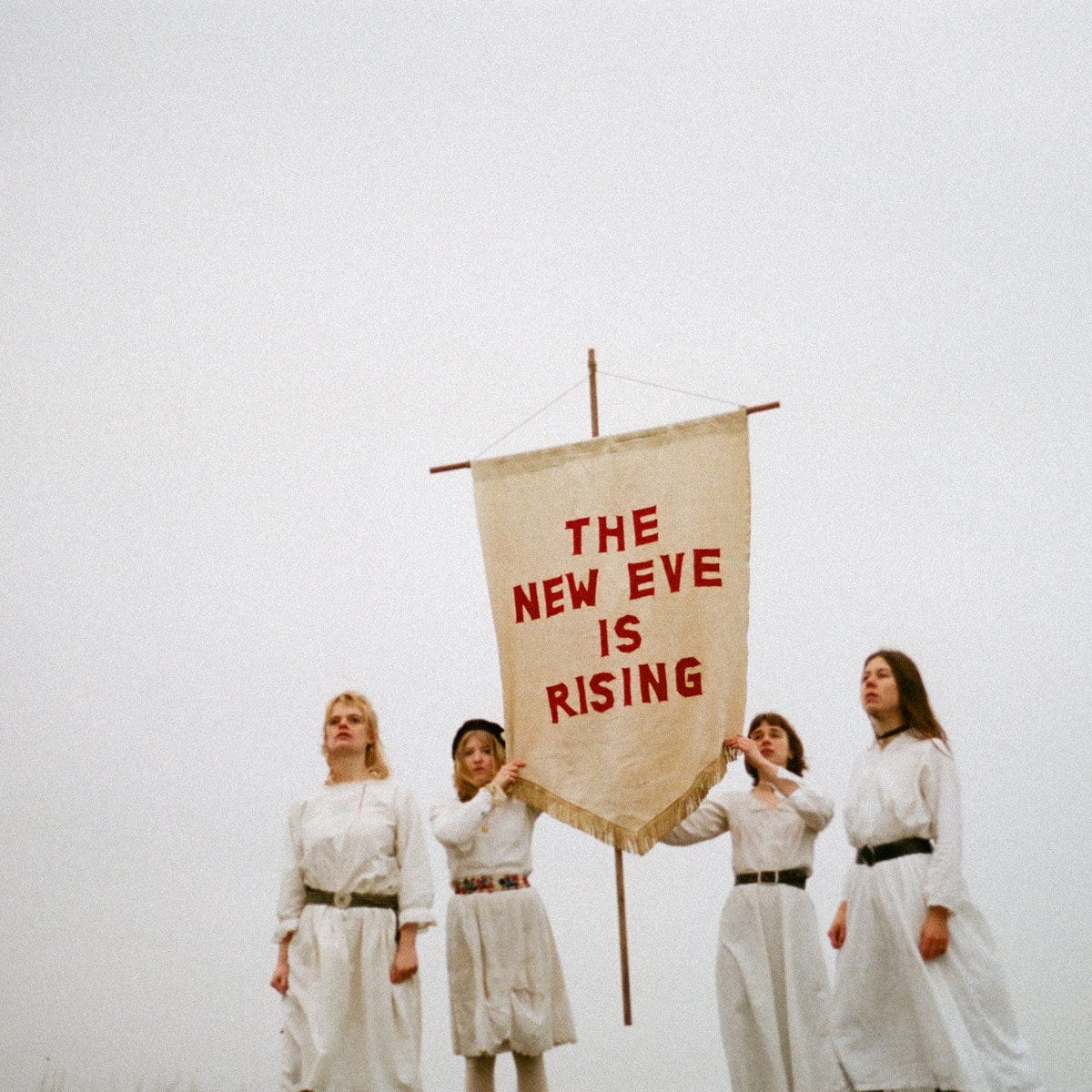
The New Eves - The New Eve Is Rising
This is the debut album from The New Eves, an all-female band from Brighton. Their songs reinterpret English folk mythology, along with themes like religion and nature, from a female perspective. They’re very musical: the four of them play various instruments, including drums, cello, violin and flute, and they all sing, together or in turns. The New Eves call their music “Hagstone Rock”, inspired by hagstone folklore and by their own identification with the word “hag”. One of the most impressive and energetic bands I’ve seen live lately.
folklore | punk | mythology | freak folk | Hagstone Rock
Eartheather - Heavenly Body: If I'm the Bottle You're the Message
On Heavenly Body, her sixth studio album, American experimental artist Eartheater delivers perhaps her most accessible record yet. Whereas her music is often full of experimental electronica, this album has a certain calmness. Her work explores themes such as female identity and body horror. On Heavenly Body, she’s mainly inspired by the experiences of pregnancy and motherhood in particular. Her three-octave vocal range and classical training come into their own on this strikingly beautiful album, which is definitely in my End Of Year-list.
experimental electronica | art pop | classical | Bulgarian
There is no “old” music - only music you have already heard and music you haven’t.
Pandrogyny was a long-term art and life project by Genesis P-Orridge and their partner Lady Jaye Breyer. The idea was that the two of them would gradually merge into a single, shared identity. They called it “pandrogyne”: neither male nor female, but both at once. It’s about un-fixed gender. Both of them underwent cosmetic surgery and styling so they would look like each other. The cut-up technique P-Orridge used in writing and music (rearranging and recombining material) was extended to the body itself. They often referred to themselves as one being: Breyer P-Orridge.
You’ve discovered an interesting aspect of sounds, identity, and how society relates to it. There are some proverbs that reflect my position on this topic: “The smoke is thinner and the chimney is lower” + “The higher the cabinet, the louder it falls.”
My favorite musicians don’t often create particularly loud sounds, but... Their music reaches the depths of the soul without excessive decibels. And yes, that includes women, men, and LGBTQ+ people.